Named with love.
Built with intention.
A business is personal. Someone took a chance on it. People depend on it. Years of judgment live inside it.
That deserves care. In the questions we ask, in the things we choose to change, and in the things we know to leave alone.
Our name carries a way of working: Notice. Ask. Think. Act.
Our name carries our practice
Notice. Ask.
Think. Act.
N · A · T · A. Four initials, one way of working. Attention comes first. Questions create understanding. Judgment connects what we learn. Action gives that understanding a life in the business.
Notice.
The question that keeps coming back. The proposal that takes three days. The information only one person can find. Friction is a clue worth paying attention to.
Ask.
Why is it happening? What does the customer need? What is the team missing? Before making a task faster, understand why it exists.
Think.
Follow the consequences. A change in sales affects delivery. A promise affects support. Decide where an intervention will help the whole business.
Act.
Build the answer with the people who will use it. It may be a clearer offer, a better process or new technology. Make it useful. Check what changes.
Our point of view / Fritjof Capra
See the whole.
Find where to begin.
A change in perception.
Fritjof Capra’s The Turning Point (1982), known in Spanish as El punto crucial, helped frame an idea that resonates with us: how we see a problem shapes the answers we can imagine. The book explores a shift in worldview across science and society. His later work develops a systems view of life, grounded in relationships, patterns and context.
In that view, a living system cannot be understood through its parts alone. Its organisation emerges through their relationships. Feedback, communication and learning matter.
Further reading: The Turning Point · Principles of life
From that idea to everyday work.
For NATA, this becomes a practical way to enter a business. A delayed quote may begin with missing information. A support problem may start with a promise made in sales. We listen across those boundaries before deciding where to act.
Our creative background brings another habit: noticing relationships that are easy to overlook. Discovery comes through attention and conversation. A shared understanding makes a different decision possible.
We call that moment the point of change. Then we build one useful improvement with the people who will live with it, observe its effects and refine it.
The nata. point.
A relationship
made visible.
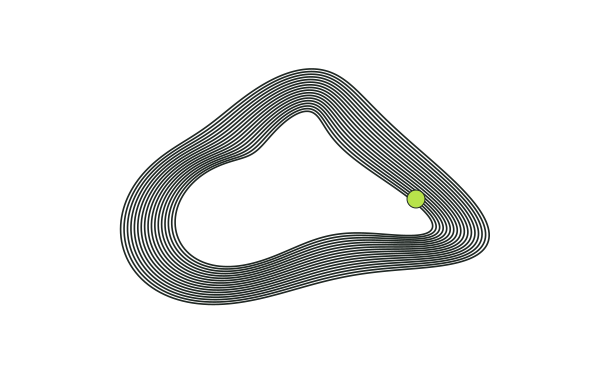
Our visual language gives that idea a form. Different contours create a shape that no single line describes. The open centre leaves room. The citron point marks a discovery within the whole.
The lines continue. The point is a place to begin, and the work keeps learning.
Partners
Two perspectives.
Shared responsibility.

Fran Herrera
Co-founder, Strategy & Operations
Fran brings a background in creative strategy, storytelling and brand identity, developed through agency work and CRUDA. His practice starts with listening: understanding what people are trying to achieve, noticing an overlooked relationship and asking the question that changes the direction of the work.
At NATA, he brings that perspective into the business itself—connecting priorities, people and everyday operations, then shaping a focused improvement the team can put into practice.
AKAleksey Korsakov
Co-founder, Engineering & Design
Aleksey brings ten years of commercial software engineering experience. His work spans multimedia products used by millions around the world and high-demand mobile payment systems within national payment infrastructure.
He has taken work from the first requirements through design, testing, launch and ongoing support. That experience brings a practical instinct for reliability: understanding what people need, making complex systems work together and taking responsibility for what happens after launch.
At NATA, he turns a shared understanding of the problem into tools and systems that fit the people using them.

Notice what others miss.
A better place to begin
What changes
when you ask
a better question?
Tell us what keeps coming back to your desk. We’ll listen, look closer and work out the next useful step together.